Selected work
Setmixer
A platform for recording live music and selling it back to the people who were in the room. I was the only frontend developer, working alongside one backend engineer. Over two years I designed and built five products, from Figma prototype to production, plus the component library all of them share.
- Role
- Frontend Developer
- Years
- 2024 — 2026
- Team
- One backend engineer
- Products
- Five, plus the component library
One of the five
The marketplace
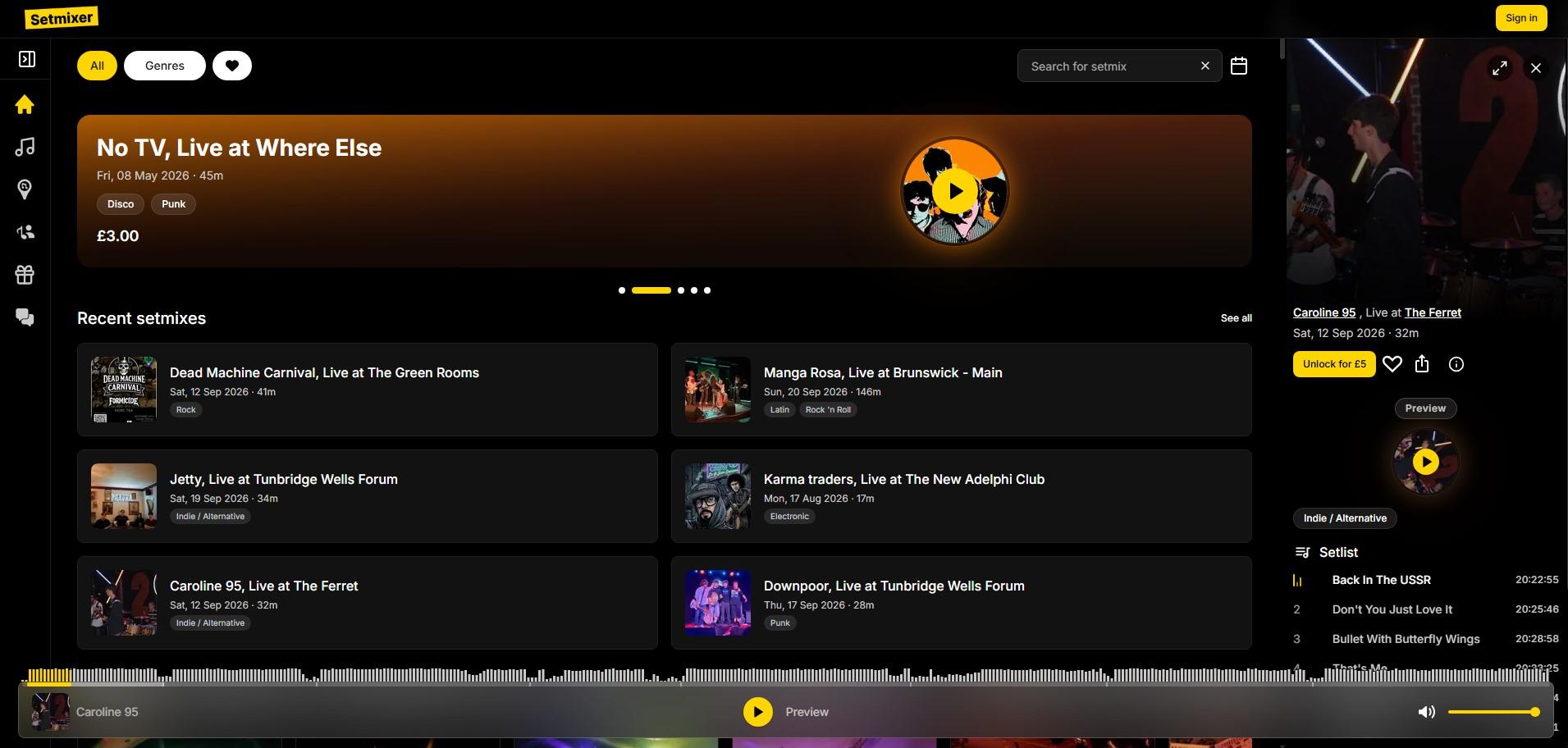
Every screen below belongs to one product out of the five. It is the only one the public sees: browsing, previewing, buying, and the builder that turns any of it into a widget for an artist’s own site. The other four sit behind a login or in the venue itself, so there are no screenshots of them here.
01/05Marketplace
A featured setmix, a grid of recent ones, and a player docked to the bottom of the app that keeps playing while you browse. Selecting a recording opens it beside the grid with its setlist and timestamps.
- Next.js
- WaveSurfer
Making it fast
Thousands of recordings, no spinners
Every night a venue records adds another set to the catalogue. People browse it the way they browse a record shop: a venue, then an artist from that bill, then back out to look for something else. Each of those hops used to cost a round trip to the server. Most of the work below went into removing them.
01Queries that run in the browser
Zero replicates the slice of the catalogue a visitor is looking at down to the browser and runs the queries there against a local store. Moving between a venue, an artist and one of their setmixes reads data that is already on the machine, so the second visit to a page waits on nothing.
02One cache for everything Zero does not own
The rest of the server state goes through TanStack Query. Components asking for the same thing share one cache entry instead of firing a request each, hovering a card prefetches it so the click opens something already loaded, and pages come back by cursor rather than offset. Page forty of the catalogue costs the same as page one.
03Lists that cost the same at any length
The recording grids and setlists only mount the rows inside the viewport. A venue page with a thousand setmixes carries as many DOM nodes as one with twenty, and scrolling stays smooth while the player keeps running underneath it.
04The page renders before the data arrives
Pages are server components that stream. The layout, the artwork and the metadata render straight away, and anything waiting on slower data arrives behind its own Suspense boundary, so one slow query cannot hold up the whole route.
- Zero
- TanStack Query
- TanStack Virtual
- React Server Components
- Suspense streaming
The other four
The rest of the platform
A set has to be captured, mixed, published and paid out before it reaches the marketplace. Each of those steps is its own product, built on the same component library.
Artist dashboard
React · Vite
An artist publishes a set here, splits the takings with the rest of the band and tracks what each recording earns.
Venue dashboard
React · Vite
A venue sees every night it has recorded, which sets are live, and what the room earned from them.
Mixing & mastering
Next.js · WaveSurfer
A multitrack editor over the raw desk feed. Every channel gets its own waveform, levels and mutes sit per track, and the finished mix renders down to the file that goes on sale.
Recorder control
Electron · SSE
A desktop app that configures the hardware recorder in the venue and streams its state back live, so a sound engineer can confirm a set is being captured without leaving the booth.